


The Slow Warm-Up

"Hands together, feet together – and begin"
This is how I start every one of my dance classes. Before we get into the true practice, it's important to prepare both our minds and our bodies for the task. Taking the time to warm up well helps guarantee a more effective practice session. Remember, dance is 50% mental and 50% physical, so both have to be warmed-up!

Why we start with a Namaskar
At the beginning and end of every dance session, whether class, practice, or performance, we center ourselves with a namaskar routine. A namaskar is a greeting, which in this case allows us dancers to acknowledge Mother Earth on whom we stamp our feet, the musicians who provide accompaniment, the deities or universal forces that have brought us to this moment, the teacher who has educated us, and the audience who supports us.
However, another layer to this ritual is that it allows us to step away from the business and distraction of the day, focus our minds, and begin our dance with purpose. It is also why we often begin, even before the namaskar, by reciting slokas (verses) honoring the lord of dance (Nataraja), the goddess of wisdom (Saraswati), the divine teachers and keepers of the cosmic cycle (Brahma, Vishnu, Shiva), and the remover of obstacles (Ganesha).
While some dancers may value this recitation practice for the religious aspects, I value it more for its other benefits. In reciting these slokas, we remind ourselves of the work we are doing, and that we are lifelong students of an art form much bigger than us. We awaken our minds by practicing memorization, and by doing namaskar again at the end, we take a moment to recognize and acknowledge the progress we have made that day.

Touch your toes, bend side to side
Once our minds are focused, we awaken our limbs with simple stretches. Slowly raising your arms above your head, then bending over to reach for your toes, and finally rolling upright from the base of the back to the head helps to align your spine vertically. We then move through the positions – lunges, side bends, half- and full-squats (aramandi & muramandi), twists, pointed and flexed feet, and wrist rotations – that we are likely to encounter in our practice. It's best to do this while maintaining the mental peace you reached with your namaskar – stay silent, move slowly, and breathe through every position.
Jump, jog, warm up!
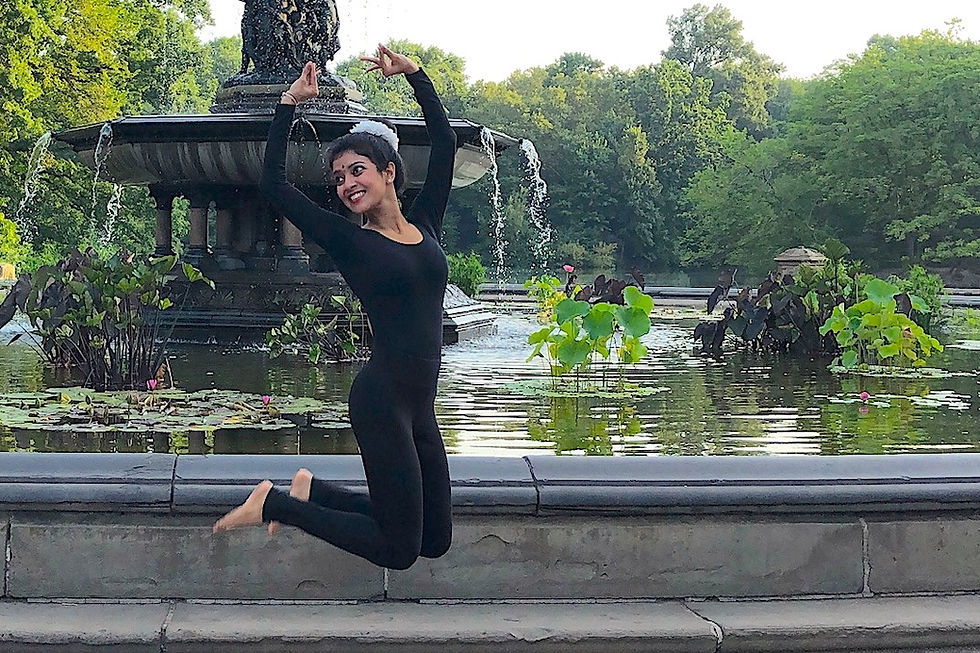
Once your body feels a bit looser with light stretching, and your mind is centered on your practice, it's time to energize! To warm up our muscles, we can jump, run in place, do arm circles, or skip rope. We can also do active stretches like kicks or lunges across the room, side-to-side lunges, or cycling through from standing (samam) to squatting (muramandi). Light muscle-building exercises like push-ups, crunches, or arm curls. These exercises help to get us a little sweaty and ready to start dancing without injuring ourselves.
Finally, start your practice with practicing a few basic movement combos like adavus or jatis. These will help you to focus in on honing your technique, rather than jumping straight into running pieces.
What is your favorite way to warm-up before practice? Do you have a favorite stretch or exercise? What about cool-down tips?


Comments